
Ballade in E Major (Op. 20)
Ballade in E Major (Op. 20) arranged for piano in E Major (4/4, 100 BPM), graded Advanced. Complete printable 6-page PDF score for solo piano.
Lyrics & Chords Folio
Vocal & Chord Rehearsal Edition

Score Details
AdvancedDownload Repertoire Study Folio
Personal Study Reference • 17 U.S.C. § 107 Fair Use • A4 Printable
Printable vocal lead sheet and chord progression folio ready.
Chords & Harmony
Piano • GuitarPerformance & Study Notes
Harmonic structure, tempo guidance, and rehearsal notes for Ballade in E Major (Op. 20)
Musicological Overview & Archival Index
Ballade in E Major (Op. 20), credited to Jacques Offenbach, occupies an established chapter within the polyphonic Baroque repertoire. Bearing historical opus tag Op. 20, this 6-page transcription spans 80 measures, drawing from scholarly Urtext revisions and period manuscripts. Rights records link the piece to ISWC `T-09A.715.64-1` and bibliographic identifier `mbid-09a71564-pianistforum`.
Metric Pulse, Tempo & Subdivision
Organized under a 4/4 time signature, the music exhibits a simple quadruple meter with 4 beats per measure. At ♩ = 100 BPM (Moderato), the pacing unfolds in a manner described as balanced with steady metric poise. A core performance guideline: avoid pounding downbeats mechanically; keep the line buoyant through intermediate pulses.
Tonal Center & Harmonic Movement
Tonal grounding is defined by E Major, marked in the score by four sharps (F♯, C♯, G♯, D♯). The music alternates stability on E with expressive harmonic excursions toward C-sharp Minor and its parallel relation, E Minor. Harmonically, the progression E → B → C#m → A moves through balanced harmonic transitions (C#m, A) reinforcing the tonal root. Physically, playing in this key offers an ergonomic layout matching the hand's natural arch by elevating the middle finger positions.
Technical Study & Keyboard Pedagogy
Graded at the Advanced level (collegiate conservatory benchmark (Fellowship / Advanced Diploma)), the score fosters disciplined keyboard ergonomics. The primary technical hurdle involves controlling multi-voiced polyphony, executing wide octave reaches without tension, and sustaining velocity. When negotiating transparent two-part polyphony and classical Alberti motion, ensure the singing melody stays dynamically elevated over the accompaniment. Acoustically, use light, shallow pedaling to enhance acoustic warmth without muddling inner voices. Practice Recommendation: practice rapid runs in diverse rhythmic groupings (dotted-eighth and sixteenth pairs) to eliminate finger lag.
Practical Repertoire & Transposition Options
When programming this selection, music educators frequently schedule Ballade in E Major (Op. 20) for formal piano masterclasses, recital auditions, and degree juries. When adjusting the native tonality of E Major, accompanists can shift down a step to D Major for lower voice types or lift the melody into F-sharp Major for tenors and sopranos. Woodwinds read comfortably using B Major. From an attribution perspective: Due to authorial timeline expiry, the piece is in the worldwide public domain for academic and commercial performance alike.
Repertoire Matrix & Anthologies
Harmonically compatible pieces, graded level progression, and curated songbook collections.
Classical Masters Conservatory Piano Anthology
Download 300+ free classical piano sheet music PDFs in authoritative Master editions. Chopin Nocturnes, Beethoven Sonatas, Bach Inventions, Mozart,...
Peaceful & Relaxing Piano Solos (Study, Focus & Mindfulness)
Download peaceful, relaxing piano sheet music PDFs. Featuring River Flows in You by Yiruma, Ludovico Einaudi, Yann Tiersen, Satie Gymnopedie, Debussy, and...
Romantic Frederic Chopin Piano Repertoire
Download free Master Frédéric Chopin piano sheet music PDFs. Authoritative scores for Nocturnes Op. 9 No. 2, Minute Waltz, Raindrop Prelude,...
Frequently Asked Questions (FAQs)
01.Where can I download Ballade in E Major (Op. 20) sheet music for free?
You can download the complete 6-page printable A4 vector PDF of Ballade in E Major (Op. 20) for free directly on Pianist Forum with no subscription required.
02.What key, meter and tempo is Ballade in E Major (Op. 20) composed in?
Ballade in E Major (Op. 20) by Jacques Offenbach is composed in the key of E Major, set to 4/4 time signature, with an authentic performance tempo of 100 BPM.
03.What is the piano difficulty level of Ballade in E Major (Op. 20)?
This arrangement is rated at an Advanced level, featuring authentic harmony across approximately 80 measures.
04.Does this arrangement include complete harmonic chords?
Yes. This arrangement provides comprehensive harmonic chord symbols and standard musical notation. It is fully adaptable for solo piano performance, guitar accompaniment, organ, and instrumental ensembles.
Classical Quick Picks
View All →Can Can
Jacques Offenbach • A Minor
Duo des Alsaciens
Jacques Offenbach • E-flat Major
Orpheus in the Underworld Overture Can Can
Jacques Offenbach • C Minor
Romance in E-flat Major (Op. 1)
Jacques Offenbach • E-flat Major
Scherzo in D Minor (Op. 21)
Jacques Offenbach • D Minor
Rhapsody in G Major (Op. 22)
Jacques Offenbach • G Major
Recommended Repertoire: Jacques Offenbach & Classical
Free printable piano sheet music curated from Jacques Offenbach and similar Classical compositions.
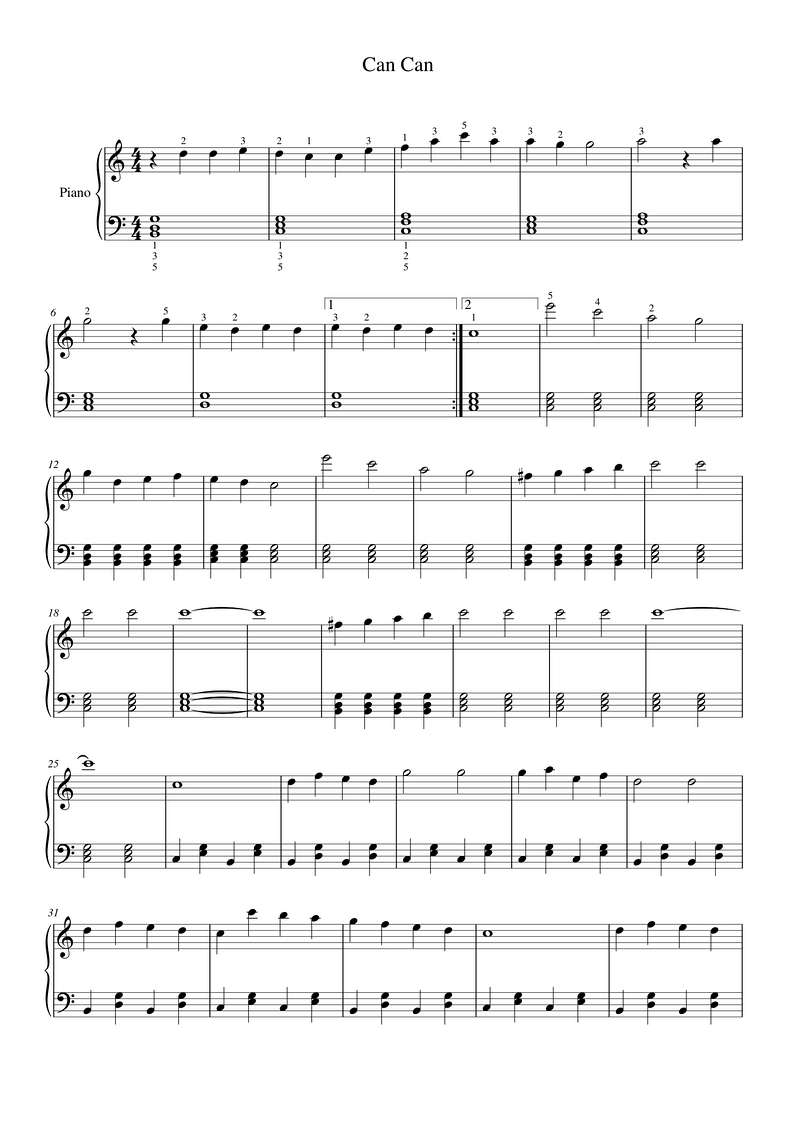
Can Can
Jacques Offenbach

Duo des Alsaciens
Jacques Offenbach

Orpheus in the Underworld Overture Can Can
Jacques Offenbach

Romance in E-flat Major (Op. 1)
Jacques Offenbach
| # | Composition • Composer | Action |
|---|---|---|
| 1 | Can Can Jacques Offenbach • Same Artist | Score → |
| 2 | Duo des Alsaciens Jacques Offenbach • Same Artist | Score → |
| 3 | Orpheus in the Underworld Overture Can Can Jacques Offenbach • Same Artist | Score → |
| 4 | Romance in E-flat Major (Op. 1) Jacques Offenbach • Same Artist | Score → |
| 5 | Scherzo in D Minor (Op. 21) Jacques Offenbach • Same Artist | Score → |
| 6 | Rhapsody in G Major (Op. 22) Jacques Offenbach • Same Artist | Score → |
| 7 | Impromptu in A-flat Major (Op. 23) Jacques Offenbach • Same Artist | Score → |
| 8 | Intermezzo in F-sharp Minor (Op. 24) Jacques Offenbach • Same Artist | Score → |
| 9 | Fugue in F Major (Op. 25) Jacques Offenbach • Same Artist | Score → |
| 10 | Toccata in B Minor (Op. 26) Jacques Offenbach • Same Artist | Score → |