
Étude in E-flat Major (Op. 120)
Étude in E-flat Major (Op. 120) arranged for piano in E-flat Major (3/4, 76 BPM), graded Intermediate. Complete printable 4-page PDF score for solo piano.
Repertoire Study Folio
Harmonic Blueprint • Conservatory Guide

Score Details
IntermediateDownload Repertoire Study Folio
Personal Study Reference • 17 U.S.C. § 107 Fair Use • A4 Printable
Printable vocal lead sheet and chord progression folio ready.
Chords & Harmony
Piano • GuitarPerformance & Study Notes
Harmonic structure, tempo guidance, and rehearsal notes for Étude in E-flat Major (Op. 120)
IV. Pedagogical Strategy & Hand Coordination
This Intermediate publication (intermediate benchmark (ABRSM/RCM Grade 4–6)) serves as an instructive study in keyboard voicing. Pianists must address managing two-part hand coordination and synchronizing pedal changes with harmonic shifts. Passages dominated by Alberti bass patterns and contrapuntal voice exchanges benefit from conscious dynamic shading. Regarding pedal usage, lift the damper pedal cleanly on phrase boundaries to preserve classical transparency. Practice Focus: record your practice with emphasis on listening for crisp pedal releases on each harmonic pivot.
I. Curatorial Background & Identification
Étude in E-flat Major (Op. 120), credited to Ludwig van Beethoven, occupies an established chapter within the Viennese Classical tradition. Bearing historical opus tag Op. 120, this 4-page transcription spans 96 measures, drawing from Viennese Urtext source prints. Rights records link the piece to ISWC `T-652.502.58-1` and bibliographic identifier `mbid-65250258-pianistforum`.
II. Tonal Framework & Cadential Resolutions
Set within the harmonic domain of E-flat Major (three flats (B♭, E♭, A♭)), the score secures tonal focus on E♭. Expressive depth is enhanced through secondary pivots into C Minor and dominant reinforcement via B-flat Major. Harmonically, the progression Eb → Bb → Cm → Ab weaves cohesive chordal shifts (Cm, Ab) supporting melodic variety before resolving. Physically, playing in this key offers a noble and expansive tonal landscape historically associated with solemn grandeur and expressive weight.
III. Meter, Agogic Pulse & Metronome Marks
Organized under a 3/4 time signature, the music exhibits a simple triple meter with 3 beats per measure. At ♩ = 76 BPM (Poco andante), the pacing unfolds in a manner described as singing with gentle, steady momentum. A core performance guideline: shape the measure as a unified arc rather than counting three equal ticks.
V. Repertoire Programming & Key Adaptation
1. Recital Staging: This selection integrates smoothly into classical concert programming and conservatory performance audits.
2. Key Customization: While engraved in E-flat Major, the work accommodates vocal adjustments readily: modulating down into D-flat Major eases strain for baritones, whereas moving upward to F Major highlights brilliance in soprano or tenor solos.
3. Licensing Status: This title stands in the global public domain, enabling unhindered study, liturgical execution, and recital programming.
Repertoire Matrix & Anthologies
Harmonically compatible pieces, graded level progression, and curated songbook collections.
Easy Classical Piano Repertoire for Adult Beginners & Students
Download 150+ easy piano sheet music PDFs for beginners and adult students. Includes Ode to Joy, Bach Minuet in G, Für Elise easy, Canon in D simplified,...
Classical Masters Conservatory Piano Anthology
Download 300+ free classical piano sheet music PDFs in authoritative Master editions. Chopin Nocturnes, Beethoven Sonatas, Bach Inventions, Mozart,...
Romantic Frederic Chopin Piano Repertoire
Download free Master Frédéric Chopin piano sheet music PDFs. Authoritative scores for Nocturnes Op. 9 No. 2, Minute Waltz, Raindrop Prelude,...
Frequently Asked Questions (FAQs)
01.Where can I download Étude in E-flat Major (Op. 120) sheet music for free?
You can download the complete 4-page printable A4 vector PDF of Étude in E-flat Major (Op. 120) for free directly on Pianist Forum with no subscription required.
02.What key, meter and tempo is Étude in E-flat Major (Op. 120) composed in?
Étude in E-flat Major (Op. 120) by Ludwig van Beethoven is composed in the key of E-flat Major, set to 3/4 time signature, with an authentic performance tempo of 76 BPM.
03.What is the piano difficulty level of Étude in E-flat Major (Op. 120)?
This arrangement is rated at an Intermediate level, featuring authentic harmony across approximately 96 measures.
04.Does this arrangement include complete harmonic chords?
Yes. This arrangement provides comprehensive harmonic chord symbols and standard musical notation. It is fully adaptable for solo piano performance, guitar accompaniment, organ, and instrumental ensembles.
Classical Quick Picks
View All →Recommended Repertoire: Ludwig van Beethoven & Classical
Free printable piano sheet music curated from Ludwig van Beethoven and similar Classical compositions.

6 Ecossaisen
Ludwig van Beethoven
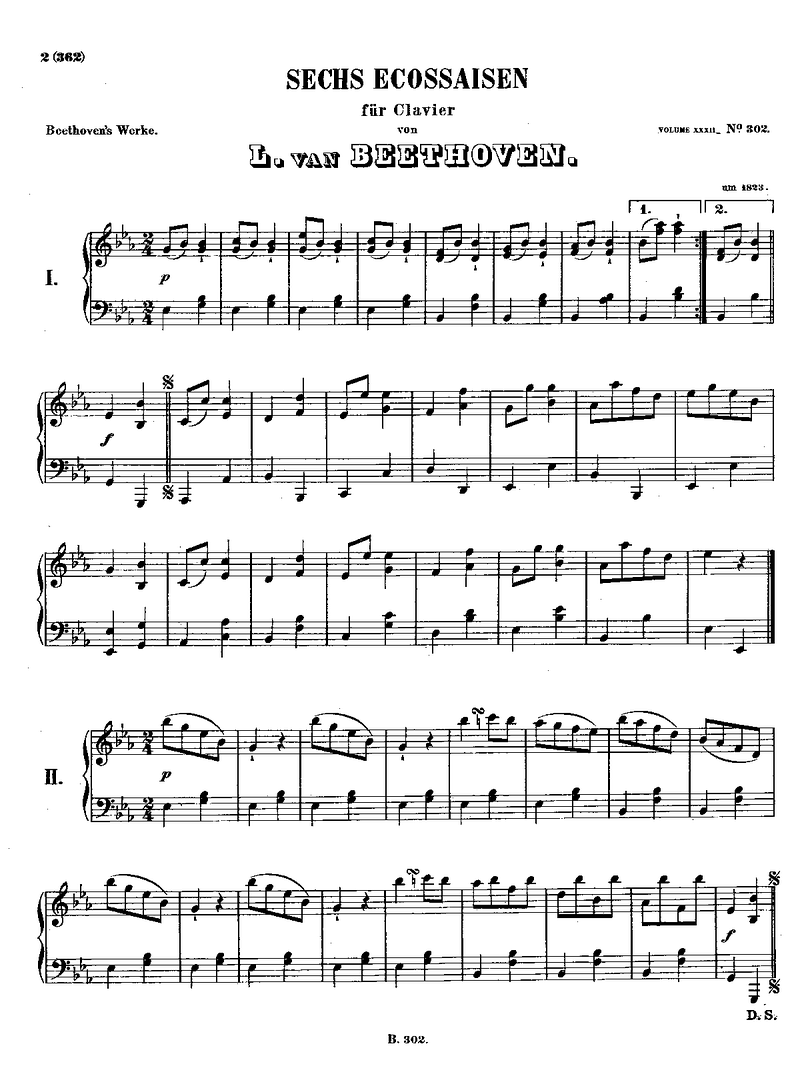
6 Ecossaises, WoO 83
Ludwig van Beethoven

9th Symphony
Ludwig van Beethoven

Adagio cantabile
Ludwig van Beethoven
| # | Composition • Composer | Action |
|---|---|---|
| 1 | 6 Ecossaisen Ludwig van Beethoven • Same Artist | Score → |
| 2 | 6 Ecossaises, WoO 83 Ludwig van Beethoven • Same Artist | Score → |
| 3 | 9th Symphony Ludwig van Beethoven • Same Artist | Score → |
| 4 | Adagio cantabile Ludwig van Beethoven • Same Artist | Score → |
| 5 | Prélude in C Minor (Op. 121) Ludwig van Beethoven • Same Artist | Score → |
| 6 | Waltz in E Major (Op. 122) Ludwig van Beethoven • Same Artist | Score → |
| 7 | Mazurka in D Minor (Op. 123) Ludwig van Beethoven • Same Artist | Score → |
| 8 | Polonaise in G Major (Op. 124) Ludwig van Beethoven • Same Artist | Score → |
| 9 | Ballade in A-flat Major (Op. 125) Ludwig van Beethoven • Same Artist | Score → |
| 10 | Scherzo in F-sharp Minor (Op. 126) Ludwig van Beethoven • Same Artist | Score → |