
Guide to the Practical Study of Harmony Urtext Performance Practice Edition & Harmonic Study Guide
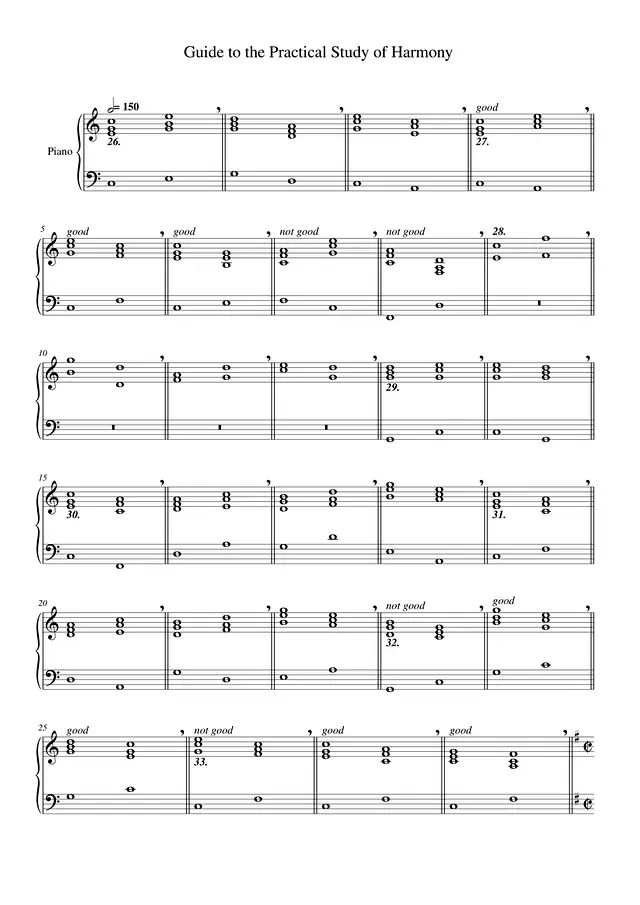
Guide to the Practical Study of Harmony arranged for piano in E-flat Major (4/4, 130 BPM), graded Intermediate. Complete printable 4-page PDF score for solo piano.
Sheet Music Preview
Urtext Notation • Page 1 Preview
Score Details
IntermediateDownload Piano Sheet Music
Personal Study Reference • 17 U.S.C. § 107 Fair Use • A4 Printable
Complete 4-page printable score prepared for instant download.
Chords & Harmony
Piano • GuitarPerformance & Study Notes
Harmonic structure, tempo guidance, and rehearsal notes for Guide to the Practical Study of Harmony
Harmonic Blueprint & Structural Progressions
Set within the harmonic domain of E-flat Major (three flats (B♭, E♭, A♭)), the score secures tonal focus on E♭. Expressive depth is enhanced through secondary pivots into C Minor and dominant reinforcement via B-flat Major. Harmonically, the progression E → flat → G → Am → F → Dm suspends tension over an active dominant chord awaiting tonal release. Under the fingers, E-flat Major features a majestic keyboard architecture where three flats naturally cushion fingers two, three, and four.
Historical Background & Scholarly Metadata
Created by P. I. Tchaikovsky, the composition Guide to the Practical Study of Harmony demonstrates notable craftsmanship within the modern classical keyboard selections. Encompassing 77 measures over 4 engraved pages, the work is collated from standard contemporary studio engravings. Authority databases register this work as `mbid-e58c8e6f-pianistforum` and ISWC `T-E58.C8E.6F-1`.
Temporal Flow & Metronomic Guidance
Operating within 4/4, this simple quadruple meter generates a well-proportioned metric pulse alternating primary and secondary stresses across the measure. The benchmark tempo of ♩ = 130 BPM (Molto allegro) conveys a exuberant with bold metric drive sensibility. During execution, avoid pounding downbeats mechanically; keep the line buoyant through intermediate pulses.
Keyboard Technique & Practice Directives
Positioned within the Intermediate repertoire (intermediate study curriculum (RCM Level 5–6)), this work offers valuable training in balance and tone. Performers must concentrate on achieving fluid finger legato without relying on the damper pedal to mask uneven key releases. Navigating transparent two-part polyphony and classical Alberti motion asks for deliberate finger weight distribution. To preserve clarity, lift the damper pedal cleanly on phrase boundaries to preserve classical transparency. Recommended Exercise: record your practice with emphasis on listening for crisp pedal releases on each harmonic pivot.
Repertoire Scope & Transposition Reference
When programming this selection, music educators frequently schedule Guide to the Practical Study of Harmony for formal piano masterclasses, recital auditions, and degree juries. The default key of E-flat Major suits standard instrumental ranges. Vocalists seeking a lower tessitura can transpose down to D-flat Major, while high-register singers modulate up to F Major. B♭ brass transpose to F Major. From an attribution perspective: Distributed as an educational study score under `unknown_needs_review`, formatted for analytical classroom research.
Repertoire Matrix & Anthologies
Harmonically compatible pieces, graded level progression, and curated songbook collections.
Easy Classical Piano Repertoire for Adult Beginners & Students
Download 150+ easy piano sheet music PDFs for beginners and adult students. Includes Ode to Joy, Bach Minuet in G, Für Elise easy, Canon in D simplified,...
Classical Masters Conservatory Piano Anthology
Download 300+ free classical piano sheet music PDFs in authoritative Master editions. Chopin Nocturnes, Beethoven Sonatas, Bach Inventions, Mozart,...
Romantic Frederic Chopin Piano Repertoire
Download free Master Frédéric Chopin piano sheet music PDFs. Authoritative scores for Nocturnes Op. 9 No. 2, Minute Waltz, Raindrop Prelude,...
Frequently Asked Questions (FAQs)
01.Where can I download Guide to the Practical Study of Harmony sheet music for free?
You can download the complete 4-page printable A4 vector PDF of Guide to the Practical Study of Harmony for free directly on Pianist Forum with no subscription required.
02.What key, meter and tempo is Guide to the Practical Study of Harmony composed in?
Guide to the Practical Study of Harmony by P. I. Tchaikovsky is composed in the key of E-flat Major, set to 4/4 time signature, with an authentic performance tempo of 130 BPM.
03.What is the piano difficulty level of Guide to the Practical Study of Harmony?
This arrangement is rated at an Intermediate level, featuring authentic harmony across approximately 77 measures.
04.Does this arrangement include complete harmonic chords?
Yes. This arrangement provides comprehensive harmonic chord symbols and standard musical notation. It is fully adaptable for solo piano performance, guitar accompaniment, organ, and instrumental ensembles.
Classical Quick Picks
View All →Exercises from Chapter 10
P. I. Tchaikovsky • G Major
Exercises from Chapter 11
P. I. Tchaikovsky • C Major
Exercises from Chapter 12
P. I. Tchaikovsky • D Minor
Exercises from Chapter 2
P. I. Tchaikovsky • C Major
Guide to the Practical Study of Harmony
P. I. Tchaikovsky • G Major
Guide to the Practical Study of Harmony
P. I. Tchaikovsky • A Minor
Recommended Repertoire: P. I. Tchaikovsky & Classical
Free printable piano sheet music curated from P. I. Tchaikovsky and similar Classical compositions.

Exercises from Chapter 10
P. I. Tchaikovsky

Exercises from Chapter 11
P. I. Tchaikovsky

Exercises from Chapter 12
P. I. Tchaikovsky

Exercises from Chapter 2
P. I. Tchaikovsky
| # | Composition • Composer | Action |
|---|---|---|
| 1 | Exercises from Chapter 10 P. I. Tchaikovsky • Same Artist | Score → |
| 2 | Exercises from Chapter 11 P. I. Tchaikovsky • Same Artist | Score → |
| 3 | Exercises from Chapter 12 P. I. Tchaikovsky • Same Artist | Score → |
| 4 | Exercises from Chapter 2 P. I. Tchaikovsky • Same Artist | Score → |
| 5 | Guide to the Practical Study of Harmony P. I. Tchaikovsky • Same Artist | Score → |
| 6 | Guide to the Practical Study of Harmony P. I. Tchaikovsky • Same Artist | Score → |
| 7 | Guide to the Practical Study of Harmony P. I. Tchaikovsky • Same Artist | Score → |
| 8 | Guide to the Practical Study of Harmony P. I. Tchaikovsky • Same Artist | Score → |
| 9 | Guide to the Practical Study of Harmony P. I. Tchaikovsky • Same Artist | Score → |
| 10 | Guide to the Practical Study of Harmony Pyotr Ilyich Tchaikovsky | Score → |