
Op. 37 Urtext Performance Practice Edition & Harmonic Study Guide
Harmonic profile, chord progression analysis, and rehearsal guide for Op. 37 by Cal Ford in F Major (4/4, 100 BPM). Repertoire facts and pedagogical performance guide.
Video Masterclass & Acoustic Performance
Acoustic Piano Video Masterclass • Tempo & Fingering Demo

Chords & Harmony
Piano • GuitarPerformance & Study Notes
Harmonic structure, tempo guidance, and rehearsal notes for Op. 37
Work Overview & Bibliographic Lineage
Originating within the modern classical keyboard selections, Op. 37 by Cal Ford exemplifies structural economy and melodic clarity. Spanning 2 pages and 41 measures, Bearing historical opus tag Op. 37, its source material derives from standard contemporary studio engravings. Catalog registries document the score under identifier `mbid-a86100e2-pianistforum` with ISWC `T-A86.100.E2-1`.
Metric Rhythm & Metronome Tempo
Organized under a 4/4 time signature, the music exhibits a simple quadruple meter with 4 beats per measure. At ♩ = 100 BPM (Andantino), the pacing unfolds in a manner described as moderately flowing with clear articulation. A core performance guideline: channel energy through the middle beats toward subsequent downbeats to preserve continuous phrasing arcs.
Piano Pedagogy & Technical Execution
Designed for Easy level pianists (elementary benchmark (ABRSM/RCM Grade 2–3)), this piece demands clean articulation and hand balance. The chief hurdle entails securing rhythmic stability between hands and navigating gentle five-finger position changes. Balancing Alberti bass patterns and contrapuntal voice exchanges requires distinct volume separation between parts. Furthermore, coordinate pedal depressions immediately after finger strikes to keep harmonies articulate. Study Routine: shadow-play the accompanimental chords silently while sounding the melodic line out loud.
Tonality, Relative Keys & Chord Architecture
Tonal grounding is defined by F Major, marked in the score by one flat (B♭). The music alternates stability on F with expressive harmonic excursions toward D Minor and its parallel relation, F Minor. Harmonically, the progression F → G → Am → Dm → G7 concludes with a questioning dominant pivot that commands forward continuation. Physically, playing in this key offers a pastoral acoustic palette where the subdominant B♭ asks for careful fourth finger extension in the right hand.
Performance Scenarios & Transposition Range
Performance Applications: In performance programming, Op. 37 is well matched for studio recitals, competitive festivals, and scholarly score readings.
Transposition Guide: Beyond the primary engraving in F Major, collaborative accompanists can adapt the key: lower voices (alto/bass) benefit from transposing into E-flat Major, while high voices gain projection in G Major. Ensembles may utilize C Major for brass fingerings.
Attribution & Rights: Distributed as an educational study score under `unknown`, formatted for analytical classroom research.
Repertoire Matrix & Anthologies
Harmonically compatible pieces, graded level progression, and curated songbook collections.
Easy Classical Piano Repertoire for Adult Beginners & Students
Download 150+ easy piano sheet music PDFs for beginners and adult students. Includes Ode to Joy, Bach Minuet in G, Für Elise easy, Canon in D simplified,...
Classical Masters Conservatory Piano Anthology
Download 300+ free classical piano sheet music PDFs in authoritative Master editions. Chopin Nocturnes, Beethoven Sonatas, Bach Inventions, Mozart,...
Peaceful & Relaxing Piano Solos (Study, Focus & Mindfulness)
Download peaceful, relaxing piano sheet music PDFs. Featuring River Flows in You by Yiruma, Ludovico Einaudi, Yann Tiersen, Satie Gymnopedie, Debussy, and...
Frequently Asked Questions (FAQs)
01.Where can I download Op. 37 sheet music for free?
You can download the complete 2-page printable A4 vector PDF of Op. 37 for free directly on Pianist Forum with no subscription required.
02.What key, meter and tempo is Op. 37 composed in?
Op. 37 by Cal Ford is composed in the key of F Major, set to 4/4 time signature, with an authentic performance tempo of 100 BPM.
03.What is the piano difficulty level of Op. 37?
This arrangement is rated at an Easy level, featuring authentic harmony across approximately 41 measures.
04.Does this arrangement include complete harmonic chords?
Yes. This arrangement provides comprehensive harmonic chord symbols and standard musical notation. It is fully adaptable for solo piano performance, guitar accompaniment, organ, and instrumental ensembles.
Recommended Repertoire: Cal Ford & Classical
Free printable piano sheet music curated from Cal Ford and similar Classical compositions.

Lentetto
Cal Ford
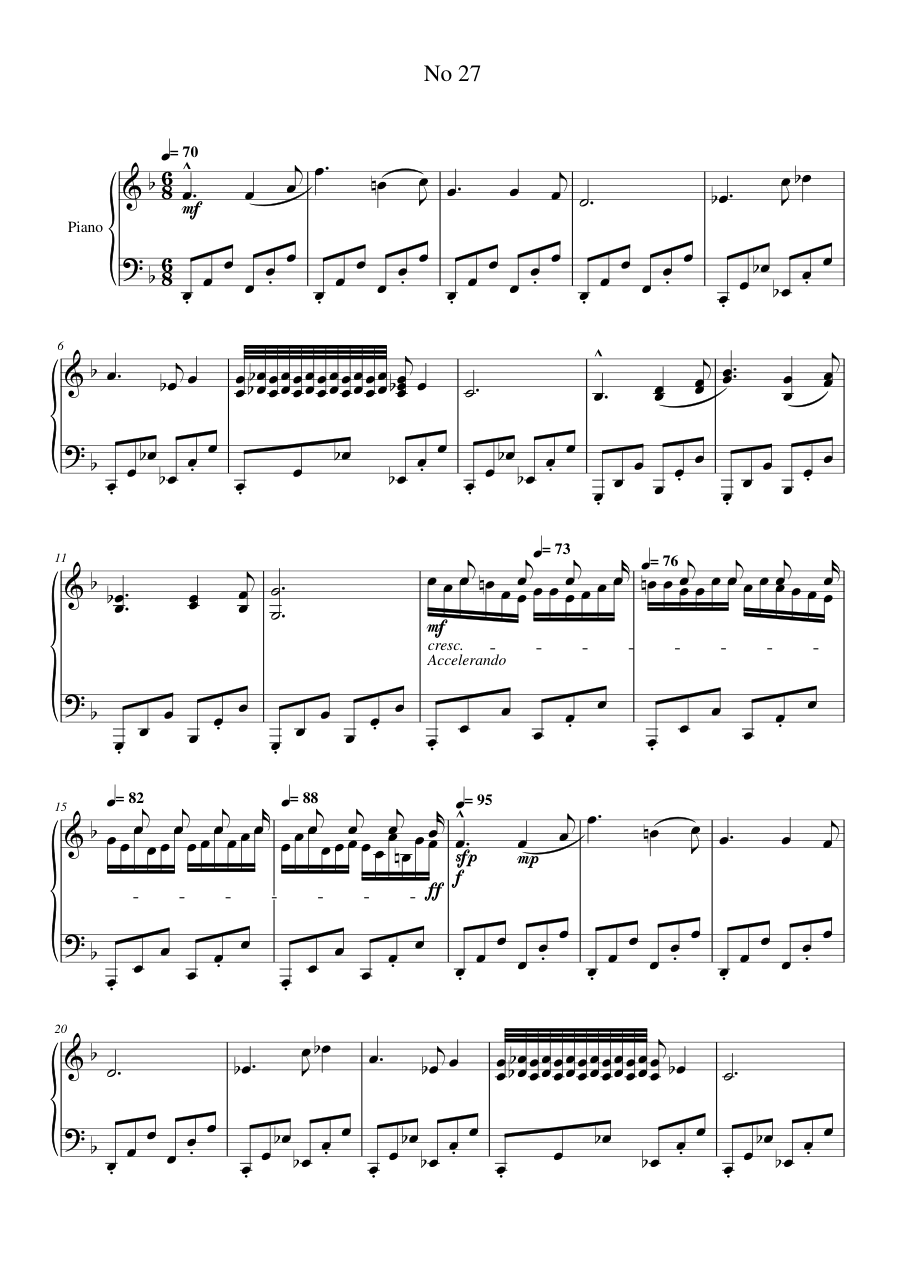
No 27
Cal Ford

No 31
Cal Ford

No 32
Cal Ford
| # | Composition • Composer | Action |
|---|---|---|
| 1 | Lentetto Cal Ford • Same Artist | Score → |
| 2 | No 27 Cal Ford • Same Artist | Score → |
| 3 | No 31 Cal Ford • Same Artist | Score → |
| 4 | No 32 Cal Ford • Same Artist | Score → |
| 5 | Op. 4 Croftdave | Score → |
| 6 | Op. 4 Croftdave | Score → |
| 7 | Op. 4 No. 2 F major Various Artists | Score → |
| 8 | Op. 4 No. 3 C Minor Leonardo Marañon | Score → |
| 9 | Op. 43 Preludio S. Vega | Score → |
| 10 | op. 5 Leonardo | Score → |