
Prélude in E Minor (Op. 16) Urtext Performance Practice Edition & Harmonic Study Guide
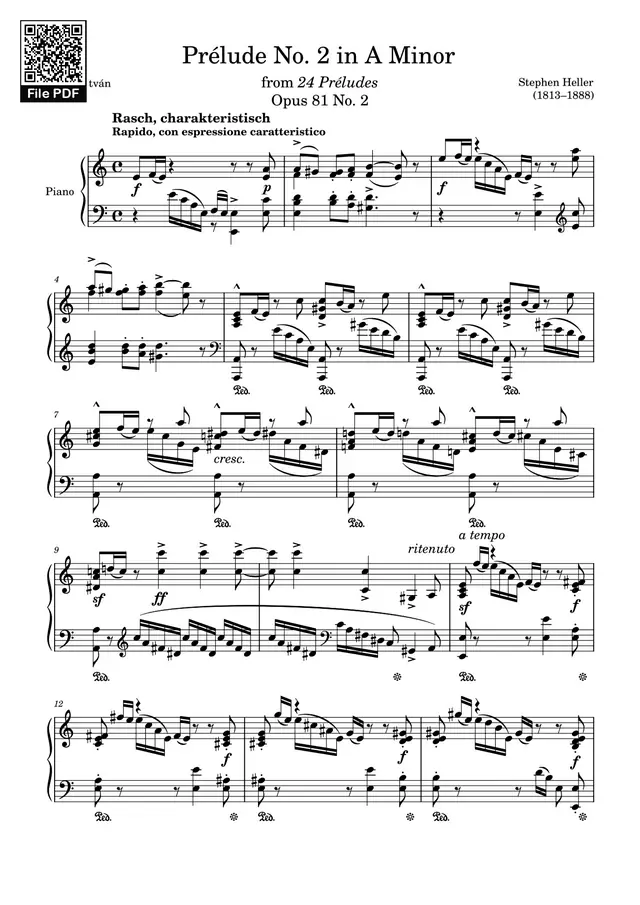
Prélude in E Minor (Op. 16) arranged for piano in E Minor (3/4, 84 BPM), graded Intermediate. Complete printable 8-page PDF score for solo piano.
Sheet Music Preview & Authorized Notation
Standard 5-Line Grand Staff • Page 1 Urtext & Pedagogical Edition

Score Details
IntermediateDownload Piano Sheet Music
Personal Study Reference • 17 U.S.C. § 107 Fair Use • A4 Printable
Complete 8-page printable score prepared for instant download.
Chords & Harmony
Piano • GuitarPerformance & Study Notes
Harmonic structure, tempo guidance, and rehearsal notes for Prélude in E Minor (Op. 16)
Historical Background & Scholarly Metadata
Created by Modest Mussorgsky, the composition Prélude in E Minor (Op. 16) demonstrates notable craftsmanship within the popular classical sheet music repertoire. Encompassing 64 measures over 8 engraved pages, Bearing historical opus tag Op. 16, the work is collated from accurate modern sheet transcriptions. Authority databases register this work as `mbid-7e77fc87-pianistforum` and ISWC `T-7E7.7FC.87-1`.
Harmonic Blueprint & Structural Progressions
Cast in E Minor (one sharp (F♯, with D♯ harmonic inflection)), the composition organizes its melodic arcs around E. Dynamic tension arises from modulatory motion toward the relative mode of G Major, balanced by harmonic stabilization from A Minor. Harmonically, the progression Em → Am → D → G → B7 achieves harmonic stability via a classic authentic closure into the final tonic. Physically, playing in this key offers an introspective minor landscape that asks for flexible wrist cushioning during expressive descents.
Keyboard Technique & Practice Directives
Pedagogically suited for Intermediate students (intermediate benchmark (ABRSM/RCM Grade 4–6)), this piece develops essential touch control. Key challenges focus on managing two-part hand coordination and synchronizing pedal changes with harmonic shifts. In sections with Alberti bass patterns and contrapuntal voice exchanges, maintain flexible forearm rotation to prevent stiffness. Pedaling requirement: coordinate pedal depressions immediately after finger strikes to keep harmonies articulate. Technical Drill: record your practice with emphasis on listening for crisp pedal releases on each harmonic pivot.
Temporal Flow & Metronomic Guidance
The temporal design is written in 3/4 (simple triple meter), establishing a graceful waltz-like momentum that unfolds across three distinct quarter-note measures. The indicated tempo mark of ♩ = 84 BPM (*Moderato grazioso*) suggests an atmosphere that is stable with buoyant, relaxed momentum. Interpretively, keep forearm weight loose on beat one while gracefully floating through beats two and three.
Repertoire Scope & Transposition Reference
Curatorial Repertoire Role: The work serves as a reliable selection for classical concert programming and conservatory performance audits.
Tessitura & Key Transposition: The default key of E Minor suits standard instrumental ranges. Vocalists seeking a lower tessitura can transpose down to D Minor, while high-register singers modulate up to F-sharp Minor. B♭ brass transpose to F-sharp Minor.
Licensing Information: This composition resides in the public domain worldwide, verified for open study, performance, and recording.
Repertoire Matrix & Anthologies
Harmonically compatible pieces, graded level progression, and curated songbook collections.
Easy Classical Piano Repertoire for Adult Beginners & Students
Download 150+ easy piano sheet music PDFs for beginners and adult students. Includes Ode to Joy, Bach Minuet in G, Für Elise easy, Canon in D simplified,...
Classical Masters Conservatory Piano Anthology
Download 300+ free classical piano sheet music PDFs in authoritative Master editions. Chopin Nocturnes, Beethoven Sonatas, Bach Inventions, Mozart,...
Romantic Frederic Chopin Piano Repertoire
Download free Master Frédéric Chopin piano sheet music PDFs. Authoritative scores for Nocturnes Op. 9 No. 2, Minute Waltz, Raindrop Prelude,...
Frequently Asked Questions (FAQs)
01.Where can I download Prélude in E Minor (Op. 16) sheet music for free?
You can download the complete 8-page printable A4 vector PDF of Prélude in E Minor (Op. 16) for free directly on Pianist Forum with no subscription required.
02.What key, meter and tempo is Prélude in E Minor (Op. 16) composed in?
Prélude in E Minor (Op. 16) by Modest Mussorgsky is composed in the key of E Minor, set to 3/4 time signature, with an authentic performance tempo of 84 BPM.
03.What is the piano difficulty level of Prélude in E Minor (Op. 16)?
This arrangement is rated at an Intermediate level, featuring authentic harmony across approximately 64 measures.
04.Does this arrangement include complete harmonic chords?
Yes. This arrangement provides comprehensive harmonic chord symbols and standard musical notation. It is fully adaptable for solo piano performance, guitar accompaniment, organ, and instrumental ensembles.
Classical Quick Picks
View All →Recommended Repertoire: Modest Mussorgsky & Classical
Free printable piano sheet music curated from Modest Mussorgsky and similar Classical compositions.

Baba Yaga
Modest Mussorgsky

Hopak
Modest Mussorgsky

Il Vecchio Castello
Modest Mussorgsky

Impromptu in E♭ Minor
Modest Mussorgsky
| # | Composition • Composer | Action |
|---|---|---|
| 1 | Baba Yaga Modest Mussorgsky • Same Artist | Score → |
| 2 | Hopak Modest Mussorgsky • Same Artist | Score → |
| 3 | Il Vecchio Castello Modest Mussorgsky • Same Artist | Score → |
| 4 | Impromptu in E♭ Minor Modest Mussorgsky • Same Artist | Score → |
| 5 | Waltz in C Major (Op. 17) Modest Mussorgsky • Same Artist | Score → |
| 6 | Mazurka in E-flat Major (Op. 18) Modest Mussorgsky • Same Artist | Score → |
| 7 | Polonaise in C Minor (Op. 19) Modest Mussorgsky • Same Artist | Score → |
| 8 | Ballade in E Major (Op. 20) Modest Mussorgsky • Same Artist | Score → |
| 9 | Scherzo in D Minor (Op. 21) Modest Mussorgsky • Same Artist | Score → |
| 10 | Rhapsody in G Major (Op. 22) Modest Mussorgsky • Same Artist | Score → |