
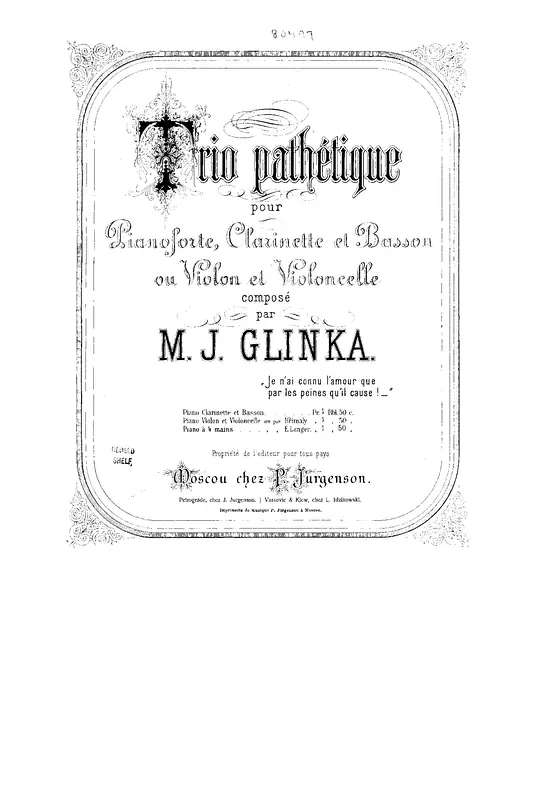
Trio pathétique
Trio pathétique arranged for piano in C Major (4/4, 92 BPM), graded Intermediate. Complete printable 3-page PDF score for solo piano.
Sheet Music Preview
Urtext Notation • Page 1 Preview
Score Details
IntermediateDownload Piano Sheet Music
Personal Study Reference • 17 U.S.C. § 107 Fair Use • A4 Printable
Complete 3-page printable score prepared for instant download.
Performance & Study Notes
Harmonic structure, tempo guidance, and rehearsal notes for Trio pathétique
Analytical Dossier: Tonal Grammar
Cast in C Major (zero sharps and zero flats), the composition organizes its melodic arcs around C. Dynamic tension arises from modulatory motion toward the relative mode of A Minor, balanced by harmonic stabilization from F Major. Voice leading proceeds primarily through diatonic harmonic motion involving tonic, subdominant, and dominant degrees. Under the fingers, C Major features an unadorned keyboard topography requiring precise thumb tucks without black-key tactile markers.
Analytical Dossier: Metric Subdivision
Metric propulsion relies on 4/4 (simple quadruple meter), giving the piece a well-proportioned metric pulse alternating primary and secondary stresses across the measure. Set to a metronome speed of ♩ = 92 BPM (*Moderato grazioso*), the overall character feels stable with buoyant, relaxed momentum. Pianists should ensure that they avoid pounding downbeats mechanically; keep the line buoyant through intermediate pulses.
Analytical Dossier: Work Attribution
Attributed to Mikhail Glinka, Trio pathétique forms an integral entry in the contemporary classical piano repertory. Laid out across 3 pages containing 48 measures, this score draws authenticity from standard contemporary studio engravings. Work tracking associates this edition with ISWC identifier `T-513.A5F.A1-1` and registry `mbid-513a5fa1-pianistforum`. Contextual research indicates: Composed by Mikhail Glinka. Preserved in classical music archives and libraries worldwide as a public domain conservatory masterpiece.
Analytical Dossier: Performance Mechanics
Designed for Intermediate level pianists (intermediate study curriculum (RCM Level 5–6)), this piece demands clean articulation and hand balance. The chief hurdle entails achieving fluid finger legato without relying on the damper pedal to mask uneven key releases. Balancing transparent two-part polyphony and classical Alberti motion requires distinct volume separation between parts. Furthermore, coordinate pedal depressions immediately after finger strikes to keep harmonies articulate. Technical Drill: record your practice with emphasis on listening for crisp pedal releases on each harmonic pivot. Score pointer: Follow the composer's harmonic progression. Focus on balanced voicing between the melody and accompaniment, observing tempo rubato and pedal markings.
Analytical Dossier: Context & Key Transposition
1. Recital Staging: This selection integrates smoothly into conservatory juries, competition recitals, and academic examinations.
2. Key Customization: To accommodate diverse vocal registers, accompanists can transpose the C Major score: baritones rest easily in B-flat Major, while lyric tenors and high soloists project effortlessly in D Major.
3. Licensing Status: Historical copyright on this musical work has expired globally, permitting unrestricted educational and concert use.
Repertoire Matrix & Anthologies
Harmonically compatible pieces, graded level progression, and curated songbook collections.
Easy Classical Piano Repertoire for Adult Beginners & Students
Download 150+ easy piano sheet music PDFs for beginners and adult students. Includes Ode to Joy, Bach Minuet in G, Für Elise easy, Canon in D simplified,...
Classical Masters Conservatory Piano Anthology
Download 300+ free classical piano sheet music PDFs in authoritative Master editions. Chopin Nocturnes, Beethoven Sonatas, Bach Inventions, Mozart,...
Romantic Frederic Chopin Piano Repertoire
Download free Master Frédéric Chopin piano sheet music PDFs. Authoritative scores for Nocturnes Op. 9 No. 2, Minute Waltz, Raindrop Prelude,...
Frequently Asked Questions (FAQs)
01.Where can I download Trio pathétique sheet music for free?
You can download the complete 3-page printable A4 vector PDF of Trio pathétique for free directly on Pianist Forum with no subscription required.
02.What key, meter and tempo is Trio pathétique composed in?
Trio pathétique by Mikhail Glinka is composed in the key of C Major, set to 4/4 time signature, with an authentic performance tempo of 92 BPM.
03.What is the piano difficulty level of Trio pathétique?
This arrangement is rated at an Intermediate level, featuring authentic harmony across approximately 48 measures.
04.Does this arrangement include complete harmonic chords?
Yes. This arrangement provides comprehensive harmonic chord symbols and standard musical notation. It is fully adaptable for solo piano performance, guitar accompaniment, organ, and instrumental ensembles.
Classical Quick Picks
View All →Recommended Repertoire: Mikhail Glinka & Classical
Free printable piano sheet music curated from Mikhail Glinka and similar Classical compositions.

2 Waltzes
Mikhail Glinka

20 Ausgewählte Lieder
Mikhail Glinka

3 Fugues
Mikhail Glinka

3 Russische Lieder
Mikhail Glinka
| # | Composition • Composer | Action |
|---|---|---|
| 1 | 2 Waltzes Mikhail Glinka • Same Artist | Score → |
| 2 | 20 Ausgewählte Lieder Mikhail Glinka • Same Artist | Score → |
| 3 | 3 Fugues Mikhail Glinka • Same Artist | Score → |
| 4 | 3 Russische Lieder Mikhail Glinka • Same Artist | Score → |
| 5 | Variations on Alyabyev's Romance 'The Nightingale' Mikhail Glinka • Same Artist | Score → |
| 6 | Variations on a Theme from 'Die Zauberflöte' Mikhail Glinka • Same Artist | Score → |
| 7 | Chant du pêcheur Mily Balakirev | Score → |
| 8 | Gondolier's Song Mily Balakirev | Score → |
| 9 | Islamey, Op.18 Mily Balakirev | Score → |
| 10 | Mazurka No.2 Mily Balakirev | Score → |