
3 Walzer
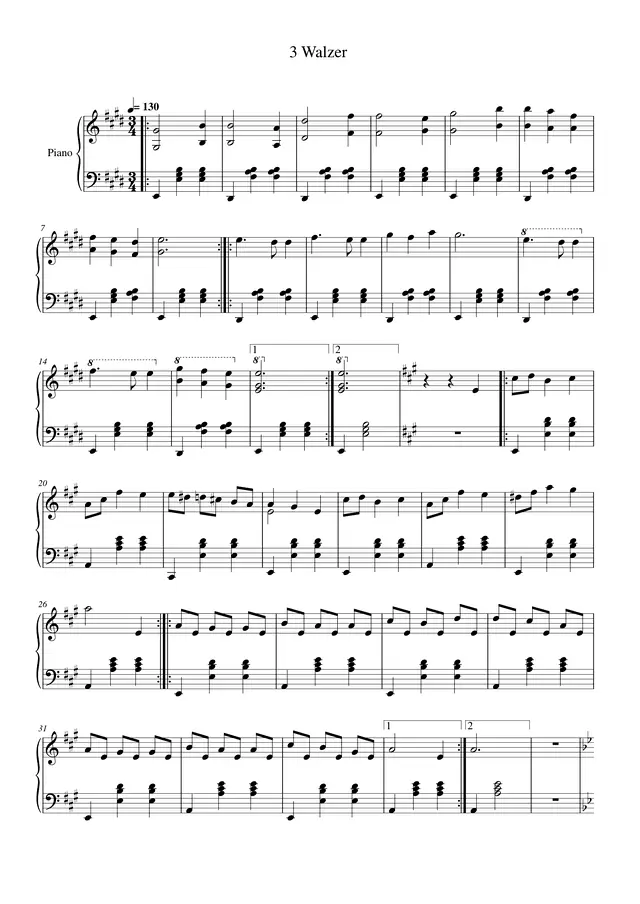
3 Walzer arranged for piano in E Minor (4/4, 121 BPM), graded Easy. Complete printable 2-page PDF score for solo piano.
Sheet Music Preview
Page 1 of 2
Score Details
EasyDownload Piano Sheet Music
Personal Study Reference • 17 U.S.C. § 107 Fair Use • A4 Printable
Complete 2-page printable score prepared for instant download.
Chords & Harmony
Piano • GuitarPerformance & Study Notes
Harmonic structure, tempo guidance, and rehearsal notes for 3 Walzer
1. Work Provenance & Archival Genesis
The 3 Walzer of Franz Schubert occupy an important position within the vast corpus of the composer’s short dance music. Schubert produced hundreds of Ländler, Deutsche Tänze, Écossaises, and Waltzes intended not primarily for the public concert platform but for the vibrant culture of Viennese domestic music making. These miniature dances emerged from the social environment of early nineteenth-century Vienna, where amateur performance and salon gatherings provided fertile ground for concise character pieces. Although modest in scale, Schubert’s dance miniatures frequently reveal the same melodic sophistication, harmonic sensitivity, and lyrical instinct that characterize his larger piano sonatas and chamber works.
Within the framework of the Pianist Forum Conservatory Edition, the 3 Walzer in E Minor may be understood as representative examples of Schubert’s ability to compress expressive content into an economical structure. Their brevity should never be mistaken for compositional simplicity. Schubert's dance writing often disguises subtle tonal inflections, elegant phrase asymmetries, and refined voice-leading beneath apparently straightforward textures. The standard two-page engraving reflects both the concise formal dimensions of the work and its intended accessibility to capable amateur pianists.
Historically, Schubert’s waltzes belong to the formative period of the Viennese waltz tradition, predating the later symphonic expansion of the genre by Johann Strauss II. In Schubert’s hands, the waltz remains intimate rather than theatrical. The music speaks in a conversational tone, emphasizing cantabile expression and harmonic nuance rather than virtuoso display. Consequently, performers should approach these pieces not as pedagogical exercises but as miniature artistic statements requiring stylistic authenticity, elegance, and textual fidelity.
The designation of technical difficulty: Easy refers principally to the absence of large stretches, rapid passagework, or advanced contrapuntal demands. Musically, however, the pieces require cultivated taste. The pianist must project phrase shape, harmonic direction, and coloristic refinement despite the compact dimensions of the score. Such challenges make the work particularly valuable within conservatory training, where the cultivation of mature musicianship often begins in repertoire of apparent simplicity.
- ✨--
2. Tonal Architecture & Harmonic Trajectory
The tonal foundation of the work is E minor, a key often associated in Classical and early Romantic literature with introspection, restrained melancholy, and lyrical gravity. Schubert exploits these expressive associations while maintaining the graceful dance character of the waltz. The result is a compelling fusion of elegance and emotional depth.
From a harmonic perspective, E minor presents a rich network of relationships. The tonic triad (E-G-B) establishes the primary tonal identity, while the dominant region, centered on B major or B7, provides the principal source of directional tension. Performers should listen carefully for the appearance of D-sharp, the leading tone of E minor, as it frequently acts as a gravitational force drawing the music toward cadential resolution. These dominant-inflected moments must be voiced with heightened awareness so that harmonic momentum remains audible throughout even the shortest phrases.
Particularly significant is Schubert’s relationship between the tonic minor and its relative major, G major. The relative-major area serves as an expressive brightening mechanism, allowing the music to emerge temporarily from the shadowed atmosphere of E minor. Such excursions should not be exaggerated. Rather, they should sound like a subtle illumination within the broader tonal landscape. A sophisticated pianist shapes these transitions through tone color rather than merely dynamic increase.
The subdominant sphere likewise contributes expressive variety. Progressions involving A minor or related pre-dominant harmonies often soften the harmonic profile and create a sense of lyrical expansion before the dominant reasserts structural control. Schubert’s gift lies in making small harmonic gestures feel psychologically significant. What appears to be a simple tonic-subdominant-dominant progression often contains delicately balanced inner voices that deserve careful projection.
Cadential design in these waltzes typically relies on clarity rather than complexity. Authentic cadences serve structural and rhythmic purposes simultaneously, reinforcing both phrase endings and dance symmetry. For the performer, this means avoiding excessive rubato at points where harmonic closure already provides sufficient expressive weight. The most persuasive interpretations allow harmonic events themselves to communicate the music’s architecture.
Throughout the work, voice-leading deserves special attention. Inner tones frequently connect harmonies through stepwise motion, creating continuity beneath the surface simplicity of the dance texture. Advanced listeners will recognize that Schubert’s harmonic language often derives its expressive power not from chromatic abundance but from exceptionally elegant connections between neighboring harmonic regions. Revealing those connections is central to an artistically convincing performance.
- ✨--
3. Metric Design, Pacing & Agogic Phrasing
Although this edition identifies a 4/4 meter and a performance pace around quarter note = 121, the fundamental challenge remains maintaining a convincing dance impulse while preserving Schubertian lyricism. Meter must never become mechanically rigid. Instead, the pulse should function as a living framework within which phrase contours breathe naturally.
The moderate tempo invites a balance between forward motion and expressive flexibility. At approximately 121 beats per minute, the performer must resist two opposite dangers: excessive haste that trivializes melodic expression and excessive relaxation that weakens rhythmic vitality. The ideal pacing preserves the gentle buoyancy of the dance while allowing melodic gestures sufficient time to sing.
Schubert’s phrases frequently exhibit elegant periodic structures. Four-measure and eight-measure units predominate, yet they often contain subtle internal negotiations of tension and release. The pianist should identify phrase apexes early in the study process. These climactic notes rarely occur by accident; they frequently coincide with harmonic arrival points, registral peaks, or moments of intensified dissonance. A well-shaped phrase gradually accumulates energy toward such points before naturally receding.
Agogic nuance represents one of the most refined aspects of performance practice in this repertoire. Small temporal inflections are entirely appropriate when they emerge from harmonic and melodic logic. A slight lingering on an expressive appoggiatura, a gentle broadening toward a cadence, or a momentary relaxation at a phrase ending can enrich the musical narrative. However, such modifications must remain proportionate. The underlying pulse should always remain perceptible.
The left hand frequently provides the dance foundation, while the right hand carries melodic discourse. Coordination between these layers is essential. Advanced pianists often imagine the left hand operating as an unobtrusive conductor, maintaining rhythmic continuity while the soprano line exercises modest rhetorical freedom. This approach produces a texture that feels simultaneously stable and expressive.
Particular care should be taken at phrase boundaries. Many young pianists create unwanted interruptions by overemphasizing rests or breathing points. Schubert’s phrases generally connect organically. Even where cadences provide closure, the subsequent phrase often emerges as a continuation of a larger narrative. The performer should therefore cultivate continuity of musical thought across formal divisions.
- ✨--
4. Technical Hurdles, Voicing & Damper Pedaling
Despite the designation of easy technical difficulty, these waltzes contain numerous subtleties that distinguish a merely correct reading from an artistically persuasive performance. The foremost technical challenge is the production of a singing melodic line above an unobtrusive accompaniment.
The right hand must prioritize melodic projection at all times. Even when the texture appears homophonic, not all notes possess equal structural importance. The soprano voice generally functions as the primary expressive agent and therefore requires greater tonal presence. Pianists should practice isolating the melodic strand while playing accompaniment notes pianissimo. Such work develops the capacity to grade dynamic levels within a single hand.
Hand alignment contributes significantly to tonal control. Because much of the writing consists of compact chordal and intervallic formations, the wrists should remain supple and balanced. Lateral movements ought to originate from coordinated arm transport rather than isolated finger stretching. Efficient alignment promotes an even legato and reduces unnecessary muscular effort.
Fingering should be approached through the concept of fulcrum points. In lyrical passages, stable fingers such as the third finger often serve as centers of balance around which neighboring fingers operate. Establishing these localized support points helps maintain legato continuity and encourages a naturally connected melodic line. The pianist should avoid constant finger substitution unless required by a specific legato circumstance.
The left hand accompaniment must retain rhythmic clarity without intruding on melodic prominence. Students frequently overplay bass notes, creating a heavy texture inconsistent with Schubertian elegance. The ideal sonority combines rhythmic definition with dynamic restraint. Bass tones should support harmonic understanding while allowing the melodic material to remain the listener’s focus.
Damper pedaling requires equal refinement. Because the harmonic rhythm is generally moderate and the textures relatively transparent, excessive pedal obscures voice-leading and compromises stylistic integrity. The preferred approach is a series of shallow, frequent pedal changes synchronized with harmonic shifts. In E minor, where resonance can accumulate rapidly in the lower register, half-pedal techniques often prove particularly effective.
At cadential points, a slightly prolonged pedal may enhance warmth and vocality, provided the harmonic resolution remains clear. Conversely, passages containing moving inner voices frequently benefit from reduced pedal depth or complete pedal release. The guiding principle is transparency. Pedal should enrich the piano’s resonance without drawing attention to itself.
Ultimately, the greatest technical objective is tonal hierarchy. Melody, inner voices, accompaniment, and bass foundation must exist in a carefully ordered relationship. When these layers are properly balanced, the music acquires the effortless naturalness characteristic of distinguished Schubert interpretation.
- ✨--
5. Practical Repertoire Placement & Performance Insights
Within the pedagogical curriculum, the 3 Walzer in E Minor occupy a highly useful position between elementary keyboard literature and more expansive early Romantic repertoire. They provide an ideal environment for developing stylistic awareness, phrase shaping, voicing control, and refined pedaling without overwhelming the student with virtuoso demands.
For developing pianists, these works function as an introduction to the broader Schubert aesthetic. Unlike repertoire that relies heavily on technical brilliance, these dances require the performer to communicate through nuance, balance, and tonal imagination. Students who master these qualities here will find the transition to Schubert’s Impromptus, Moments Musicaux, and shorter lyrical works considerably more natural.
In recital programming, the waltzes may serve effectively as interludes, educational demonstrations of Viennese style, or components of a larger set of miniature Romantic dances. Their brevity encourages performers to think cyclically, considering how individual pieces relate to one another through contrast, continuity, and tonal progression. Even in a short sequence, narrative planning remains essential.
Interpretively, performers should avoid treating the music as sentimental salon material. Although intimate in character, Schubert’s writing possesses remarkable structural integrity. Every phrase benefits from a clear destination, every cadence from harmonic awareness, and every dynamic inflection from musical purpose. Excessive rubato, exaggerated dynamics, or overly generous pedaling can obscure the elegance inherent in the score.
The most successful performances, as emphasized in the Pianist Forum Conservatory Edition, achieve a synthesis of simplicity and sophistication. The listener should perceive a graceful dance unfolding naturally while simultaneously sensing the refined harmonic craftsmanship beneath the surface. When approached with disciplined musicianship, careful voicing, sensitive pedaling, and a deep understanding of E minor tonal relationships, these modest two-page waltzes reveal themselves as exemplary studies in Schubertian lyric expression and Classical-Romantic elegance.
Repertoire Matrix & Anthologies
Harmonically compatible pieces, graded level progression, and curated songbook collections.
Easy Classical Piano Repertoire for Adult Beginners & Students
Download 150+ easy piano sheet music PDFs for beginners and adult students. Includes Ode to Joy, Bach Minuet in G, Für Elise easy, Canon in D simplified,...
Classical Masters Conservatory Piano Anthology
Download 300+ free classical piano sheet music PDFs in authoritative Master editions. Chopin Nocturnes, Beethoven Sonatas, Bach Inventions, Mozart,...
Peaceful & Relaxing Piano Solos (Study, Focus & Mindfulness)
Download peaceful, relaxing piano sheet music PDFs. Featuring River Flows in You by Yiruma, Ludovico Einaudi, Yann Tiersen, Satie Gymnopedie, Debussy, and...
Frequently Asked Questions (FAQs)
01.Where can I download 3 Walzer sheet music for free?
You can download the complete 2-page printable A4 vector PDF of 3 Walzer for free directly on Pianist Forum with no subscription required.
02.What key, meter and tempo is 3 Walzer composed in?
3 Walzer by Franz Schubert is composed in the key of E Minor, set to 4/4 time signature, with an authentic performance tempo of 121 BPM.
03.What is the piano difficulty level of 3 Walzer?
This arrangement is rated at an Easy level, featuring authentic harmony across approximately 47 measures.
04.Does this arrangement include complete harmonic chords?
Yes. This arrangement provides comprehensive harmonic chord symbols and standard musical notation. It is fully adaptable for solo piano performance, guitar accompaniment, organ, and instrumental ensembles.
Recommended Repertoire: Franz Schubert & Classical
Free printable piano sheet music curated from Franz Schubert and similar Classical compositions.

11 Ecossaises, D. 781
Franz Schubert

Andante con moto
Franz Schubert

Auf dem Strom
Franz Schubert

Ave Maria
Franz Schubert
| # | Composition • Composer | Action |
|---|---|---|
| 1 | 11 Ecossaises, D. 781 Franz Schubert • Same Artist | Score → |
| 2 | Andante con moto Franz Schubert • Same Artist | Score → |
| 3 | Auf dem Strom Franz Schubert • Same Artist | Score → |
| 4 | Ave Maria Franz Schubert • Same Artist | Score → |
| 5 | 6 Ecossaisen Ludwig van Beethoven | Score → |
| 6 | 6 Ecossaises, WoO 83 Ludwig van Beethoven | Score → |
| 7 | 6 Kinderstücke, Op. 72 No. 2 Felix Mendelssohn | Score → |
| 8 | 6 Little Preludes, No. 2 Johann Sebastian Bach | Score → |
| 9 | 6 Polish Songs, S. 480 WiosnaSpring Frédéric François Chopin | Score → |
| 10 | 6 Preludii mici No 2 Johann Sebastian Bach | Score → |