
Guide to the Practical Study of Harmony Urtext Performance Practice Edition & Harmonic Study Guide
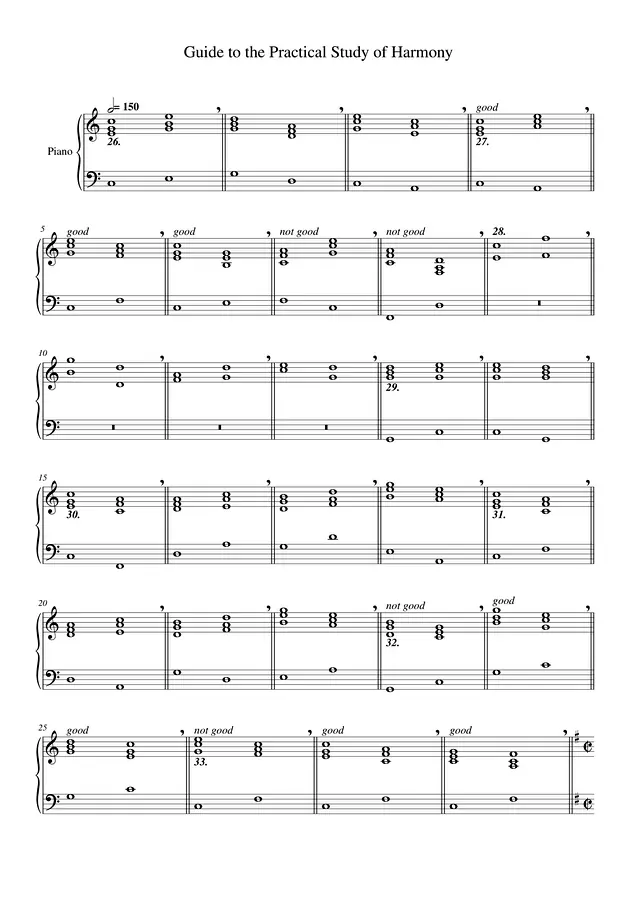
Guide to the Practical Study of Harmony arranged for piano in A Minor (4/4, 135 BPM), graded Intermediate. Complete printable 3-page PDF score for solo piano.
Sheet Music Preview & Authorized Notation
Standard 5-Line Grand Staff • Page 1 Urtext & Pedagogical Edition

Score Details
IntermediateDownload Piano Sheet Music
Personal Study Reference • 17 U.S.C. § 107 Fair Use • A4 Printable
Complete 3-page printable score prepared for instant download.
Chords & Harmony
Piano • GuitarPerformance & Study Notes
Harmonic structure, tempo guidance, and rehearsal notes for Guide to the Practical Study of Harmony
Piano Pedagogy & Technical Execution
Assigned an overall Intermediate rating (intermediate benchmark (ABRSM/RCM Grade 4–6)), the composition exercises manual independence. The central obstacle centers on projecting the cantabile soprano melody while suppressing inner accompaniment voices. In performing Alberti bass patterns and contrapuntal voice exchanges, keep finger knuckles rounded and poised. For acoustic hygiene, coordinate pedal depressions immediately after finger strikes to keep harmonies articulate. Preparatory Exercise: drill awkward chord shifts at 60% tempo, ensuring fingers assume target hand shapes before descending.
Metric Rhythm & Metronome Tempo
The temporal design is written in 4/4 (simple quadruple meter), establishing a steady common-time pulse providing natural rhythmic symmetry across four quarter-note subdivisions. The indicated tempo mark of ♩ = 135 BPM (*Allegro con brio*) suggests an atmosphere that is brisk with sparkling rhythmic excitement. Interpretively, channel energy through the middle beats toward subsequent downbeats to preserve continuous phrasing arcs.
Tonality, Relative Keys & Chord Architecture
Anchored in A Minor, this work utilizes a key signature of zero sharps and zero flats (with G♯ serving as raised harmonic seventh). The composer builds structural coherence around A, deploying the relative pole (C Major) to introduce tonal contrast before resolving through E Major. Harmonically, the progression Am → Dm → G → C → F → E7 moves through balanced harmonic transitions (F, E7) reinforcing the tonal root. From a tactile perspective, navigating this key delivers a classic keyboard canvas where the shift between natural minor and harmonic seventh requires careful thumb angle.
Work Overview & Bibliographic Lineage
Originating within the contemporary classical piano repertory, Guide to the Practical Study of Harmony by P. I. Tchaikovsky exemplifies structural economy and melodic clarity. Spanning 3 pages and 64 measures, its source material derives from accurate modern sheet transcriptions. Catalog registries document the score under identifier `mbid-896bb539-pianistforum` with ISWC `T-896.BB5.39-1`.
Performance Scenarios & Transposition Range
1. Recital Staging: This selection integrates smoothly into classical concert programming and conservatory performance audits.
2. Key Customization: Performers can shift the default tonality of A Minor according to singer comfort: a downward transition to G Minor reduces top-range vocal demands, while modulating to B Minor enhances acoustic carrying power for solo recitals.
3. Licensing Status: Distributed as an educational study score under `unknown_needs_review`, formatted for analytical classroom research.
Repertoire Matrix & Anthologies
Harmonically compatible pieces, graded level progression, and curated songbook collections.
Easy Classical Piano Repertoire for Adult Beginners & Students
Download 150+ easy piano sheet music PDFs for beginners and adult students. Includes Ode to Joy, Bach Minuet in G, Für Elise easy, Canon in D simplified,...
Classical Masters Conservatory Piano Anthology
Download 300+ free classical piano sheet music PDFs in authoritative Master editions. Chopin Nocturnes, Beethoven Sonatas, Bach Inventions, Mozart,...
Romantic Frederic Chopin Piano Repertoire
Download free Master Frédéric Chopin piano sheet music PDFs. Authoritative scores for Nocturnes Op. 9 No. 2, Minute Waltz, Raindrop Prelude,...
Frequently Asked Questions (FAQs)
01.Where can I download Guide to the Practical Study of Harmony sheet music for free?
You can download the complete 3-page printable A4 vector PDF of Guide to the Practical Study of Harmony for free directly on Pianist Forum with no subscription required.
02.What key, meter and tempo is Guide to the Practical Study of Harmony composed in?
Guide to the Practical Study of Harmony by P. I. Tchaikovsky is composed in the key of A Minor, set to 4/4 time signature, with an authentic performance tempo of 135 BPM.
03.What is the piano difficulty level of Guide to the Practical Study of Harmony?
This arrangement is rated at an Intermediate level, featuring authentic harmony across approximately 64 measures.
04.Does this arrangement include complete harmonic chords?
Yes. This arrangement provides comprehensive harmonic chord symbols and standard musical notation. It is fully adaptable for solo piano performance, guitar accompaniment, organ, and instrumental ensembles.
Classical Quick Picks
View All →Exercises from Chapter 10
P. I. Tchaikovsky • G Major
Exercises from Chapter 11
P. I. Tchaikovsky • C Major
Exercises from Chapter 12
P. I. Tchaikovsky • D Minor
Exercises from Chapter 2
P. I. Tchaikovsky • C Major
Guide to the Practical Study of Harmony
P. I. Tchaikovsky • E-flat Major
Guide to the Practical Study of Harmony
P. I. Tchaikovsky • G Major
Recommended Repertoire: P. I. Tchaikovsky & Classical
Free printable piano sheet music curated from P. I. Tchaikovsky and similar Classical compositions.

Exercises from Chapter 10
P. I. Tchaikovsky

Exercises from Chapter 11
P. I. Tchaikovsky

Exercises from Chapter 12
P. I. Tchaikovsky

Exercises from Chapter 2
P. I. Tchaikovsky
| # | Composition • Composer | Action |
|---|---|---|
| 1 | Exercises from Chapter 10 P. I. Tchaikovsky • Same Artist | Score → |
| 2 | Exercises from Chapter 11 P. I. Tchaikovsky • Same Artist | Score → |
| 3 | Exercises from Chapter 12 P. I. Tchaikovsky • Same Artist | Score → |
| 4 | Exercises from Chapter 2 P. I. Tchaikovsky • Same Artist | Score → |
| 5 | Guide to the Practical Study of Harmony P. I. Tchaikovsky • Same Artist | Score → |
| 6 | Guide to the Practical Study of Harmony P. I. Tchaikovsky • Same Artist | Score → |
| 7 | Guide to the Practical Study of Harmony P. I. Tchaikovsky • Same Artist | Score → |
| 8 | Guide to the Practical Study of Harmony P. I. Tchaikovsky • Same Artist | Score → |
| 9 | Guide to the Practical Study of Harmony P. I. Tchaikovsky • Same Artist | Score → |
| 10 | Guide to the Practical Study of Harmony P. I. Tchaikovsky • Same Artist | Score → |